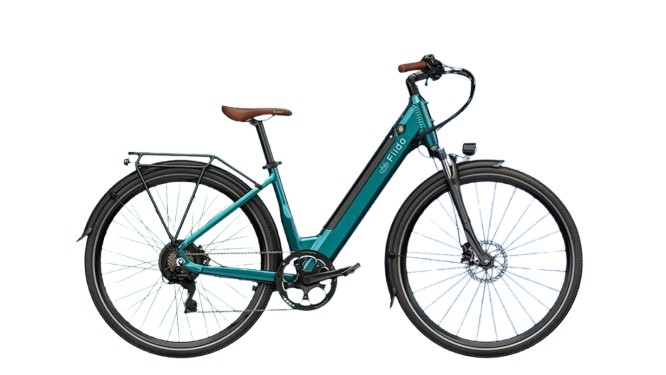
It is the question we get most often before a rental: "how far will I get on the battery?" The spec sheet for the Fiido C11 Pro we rent quotes a range of up to 100 km. That figure is true, and it does not mean what people think it means. Here is how to read it.
What "up to" means
A quoted range is measured in the most favourable conditions: assistance on the lowest setting, flat ground, no wind, a rider of average weight, few stops, a new battery and a mild temperature. Put all of that together and the number is reachable.
In real life each of those factors slips a little, and the actual range lands below. That is not misleading advertising, it is simply how range is measured, exactly like a car's quoted fuel consumption.
What actually cuts the range
In order of effect, from most to least:
- The assistance level. By far the biggest factor. Riding permanently on maximum can halve the range or worse compared with the lowest setting. It is also the one control you hold at every moment.
- Wind. On this coast, wind is the real gradient. A steady headwind demands the same effort as a continuous climb, and the motor makes up for it by drawing power.
- Total weight. Rider, bags, shopping, child seat or trailer: it all adds up.
- Stopping and starting. A ride through town with twenty stops uses more than the same distance in one go.
- Tyre pressure and cold. Two small factors, but free to fix: properly inflated tyres and a battery that has not spent the night outdoors.
Wind, the local factor
It deserves its own paragraph. Everything here is flat, so nothing warns you: you set off with the wind behind, the outward leg feels easy, and the return is straight into it with a battery already part-used. That is the scenario that catches people out, never the distance.
The rule is simple and it holds for a bike without assistance too: ride out into the wind and come back with it. And keep the high assistance level for the way back, not the way out.
Set that against our rides
This is where the answer becomes reassuring. The Vía Verde is seven kilometres, so around fifteen there and back. The La Mata lagoons are in the next district. The coast from Cabo Roig to Campoamor runs along the shore.
None of these rides comes anywhere near the limit of the battery, even on maximum assistance the whole way. Which means that on our routes, range is not the deciding factor. What counts is comfort, the wind, and whether you feel like pedalling.
Range becomes a subject again if you string two or three rides together in one day, or head out for a full day away from the coast.
Three habits that save battery
Set off on the lowest assistance level. You will be surprised how well it does on the flat, and you keep the rest in reserve.
Do not judge the remaining range on the first few kilometres. Battery gauges are optimistic early and pessimistic late: that is normal, and it does not mean the battery is failing.
And if you have to choose a moment to spend, spend it on the way back. A full battery at the end is worth nothing.
So, city bike or electric?
If it is the fear of running out that makes you hesitate, you can set that aside: on our rides it is not the issue. The real criterion lies elsewhere, and we go into it in city bike or electric bike: wind, the length of the day, and groups of mixed fitness.
Every rental includes the bike, a helmet and a lock, collected in Torrevieja (Playa de los Locos) or Orihuela Costa (Cabo Roig). Have a look at our electric bikes, our city bikes and the frequently asked questions.