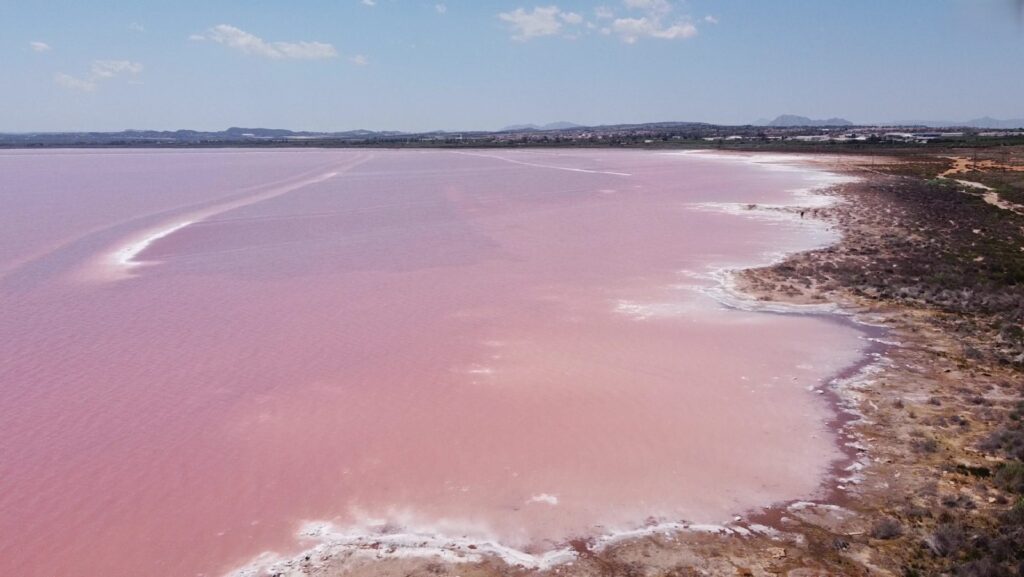
People come to Torrevieja for the sea and go home with the image of pink water. It sits in a 3,700-hectare natural park just behind the town, and a good part of it is best reached by bike. The thing worth knowing first is where you may go and where you may not, which is what this article is about.
Two lagoons, and only one you can walk freely
The natural park holds two salt lagoons. The Laguna Rosa, the Torrevieja one, is the famous one: its colour comes from its very high salinity and from the microorganisms living in it. The La Mata lagoon, to the north, is its neighbour, and together they form a wetland of international standing.
The detail to know before setting off: you do not walk into the salt pans of the Torrevieja lagoon on your own. They are visited on an organised tour, always booked in advance, by tourist train, on foot or by bike. Current details are on the official visits site. The La Mata lagoon, on the other hand, has marked trails and observation points open to visitors, and that is where you go freely.
Seeing the Laguna Rosa from the outside is still possible, and easy at that: the Vía Verde runs alongside it for several kilometres, with no traffic. The two rides pair well in a single day.
Where to start: the Casa Forestal de La Mata
The park's interpretation centre is at the Casa Forestal de La Mata. It is the right first stop: you understand what you are looking at, you get the layout of the trails, and it is where the park's guided walks start from. The centre only opens in the morning and closes on a few days of the year, so it is worth checking before you go on the park's page on the tourist board site.
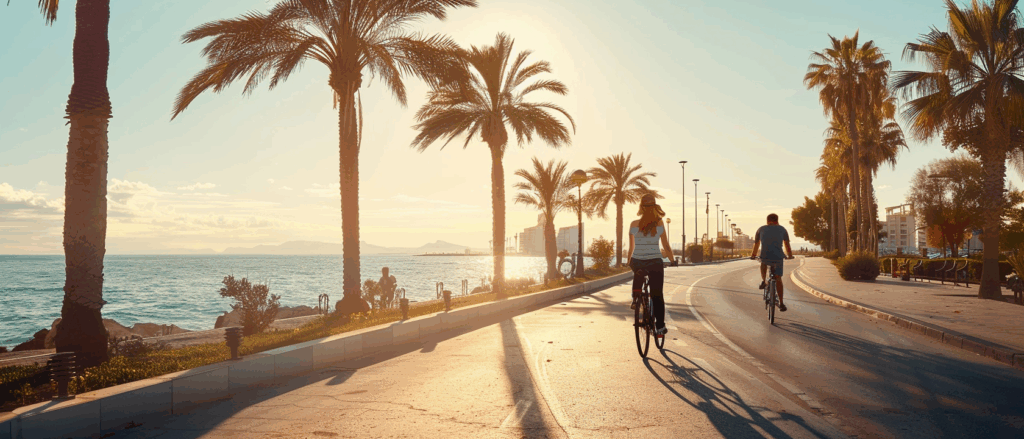
From our Playa de los Locos pick-up point, La Mata is the next district north: you follow the sea, and the park begins just behind the first houses. Nothing difficult, no climbs.
What you see
Birds, above all. The park is home to pink flamingos, avocets and black-winged stilts, and you quickly see why the hides are where they are. Around them, pine woods and salt flats make the landscape, with that very low late-afternoon light the lagoon throws back.
It is a quiet outing in a protected place. You stay on the trails, you do not approach the birds and you do not cut across the banks: the park exists precisely because this wetland is fragile.
By bike to the park, then on foot
The bike is the right way to get to the park: no parking to hunt for, and the distance from Torrevieja is short. Inside, though, the trails are mainly meant for walking and watching, so ask at the Casa Forestal what is open to bikes on the day of your visit, and expect to get off and push. Our rentals include a lock, so leaving the bike at the head of a trail is no trouble.
And if you ride back along the road afterwards, remember that the Spanish rules change on 1 October 2026: helmet compulsory as soon as you leave town.
When to go
Early, without hesitation. It is cooler, the birds are active, and the light is better both for looking and for photographs. In high summer, a midday ride across salt flats makes no sense at all: there is almost no shade.
Otherwise the kit is the same as for all our rides: closed shoes, water, sun cream, and something to cover your shoulders.
What it means for your rental
Every rental includes the bike, a helmet and a lock, collected in Torrevieja (Playa de los Locos) or Orihuela Costa (Cabo Roig). A city bike is plenty for this ride; if you string it together with the Vía Verde or with the coast from Cabo Roig to Campoamor on the same day, have a look at city bike or electric bike instead.
Our city bikes, our electric bikes and the frequently asked questions cover the rest.